
INtERACTION
Human–AI interaction in teaching and learning contexts.
View projects →Four strands carry our work from human–AI interaction, through computational modelling, to real-world intervention and adoption.
Human–AI interaction in teaching and learning contexts.
View projects →Computational and statistical models of collaboration and self-regulated learning, built from multimodal learning analytics.
View projects →Analytics feedback that supports reflection and self-regulation — and its impact in practice.
View projects →The psychological and social challenges of adopting AI and analytics in educational practice.
View projects →Human–AI interaction in teaching and learning contexts.
Online discussion forums are widely used in higher education, yet sustaining meaningful participation and deep knowledge construction remains challenging. This research investigates the impact of an AI-generated summary-driven learning design on students’ engagement, knowledge construction, and social capital in asynchronous online discussions. Adopting a design-based research methodology across four iterative cycles, the study combines learning design interventions with interviews and focus groups to examine both learning processes and student experiences. Findings indicate that the AI-generated summary-driven learning design can increase posting, replying, and viewing activity, support more students in reaching higher levels of knowledge construction, and strengthen bridging social capital within the learning community. The work contributes empirical evidence on the educational value of AI-generated learning support and offers practical design principles for integrating generative AI into online learning environments.
Computational and statistical models of collaboration and self-regulated learning, built from multimodal learning analytics.
Collaborative Problem Solving (CPS) is a multilevel process involving the perspectives of both individuals and groups, in which activated cognitive domain knowledge and the social aspects of interaction are dynamically engaged towards shared understanding (Luckin et al., 2017). Existing studies have explored the use of coaching (D’Mello et al., 2024) and social robots (Nasir et al., 2023) to support and improve aspects of CPS competency; however, just-in-time guidance on CPS processes and the alignment of such support to teaching practice remain underexplored. This research proposes an adaptive support for CPS involving scaffolding of problem-solving and collaborative processes, taking a data-driven approach to the design of an adaptive scaffold intervention. Explorations investigate the use of transformer-based models for CPS diagnosis, with these diagnoses and interventions subsequently compared to those produced by teachers as a preliminary step towards designing an adaptive scaffold intervention system that helps teachers better support students in CPS.
Analytics feedback that supports reflection and self-regulation — and its impact in practice.
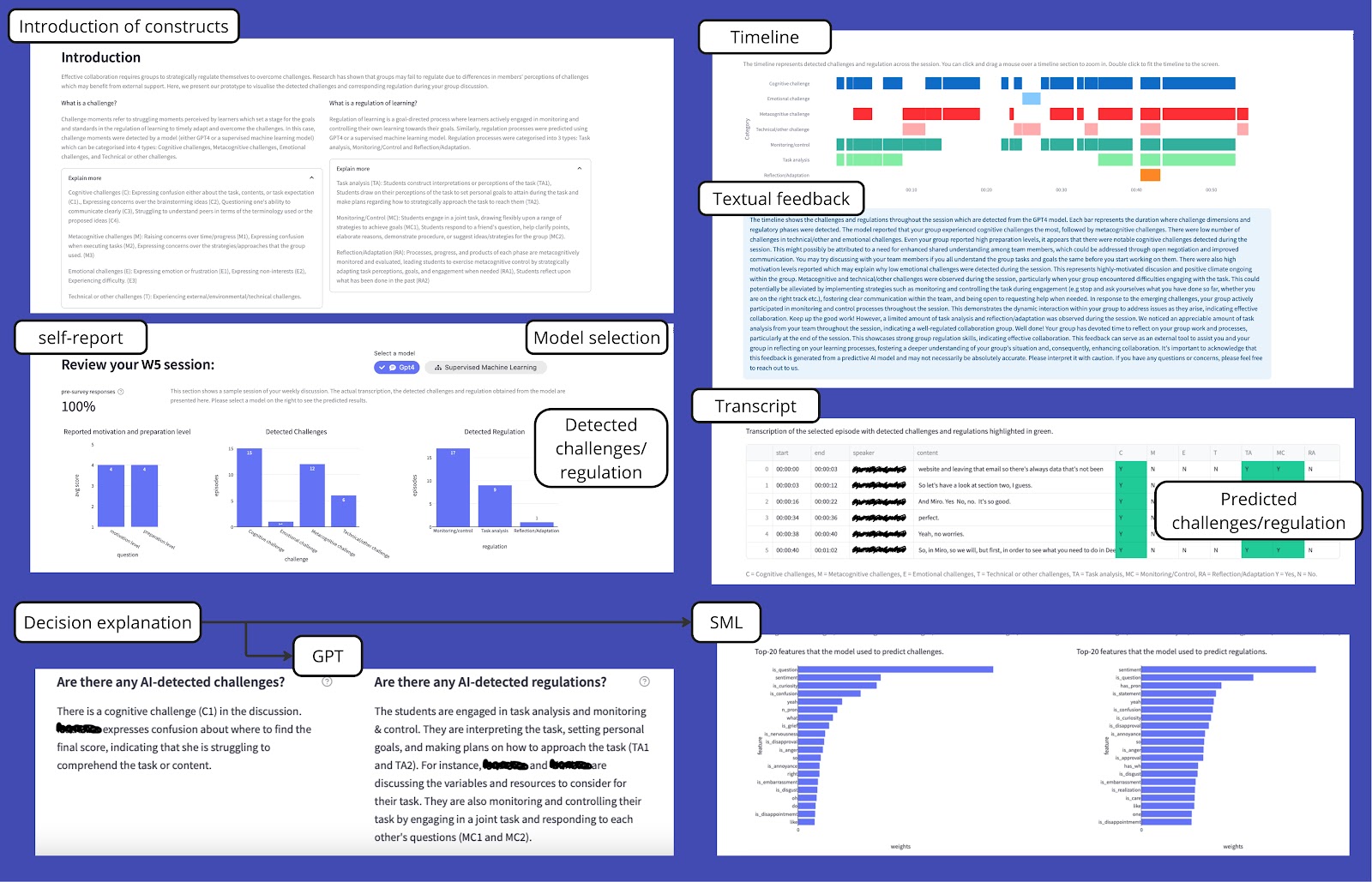
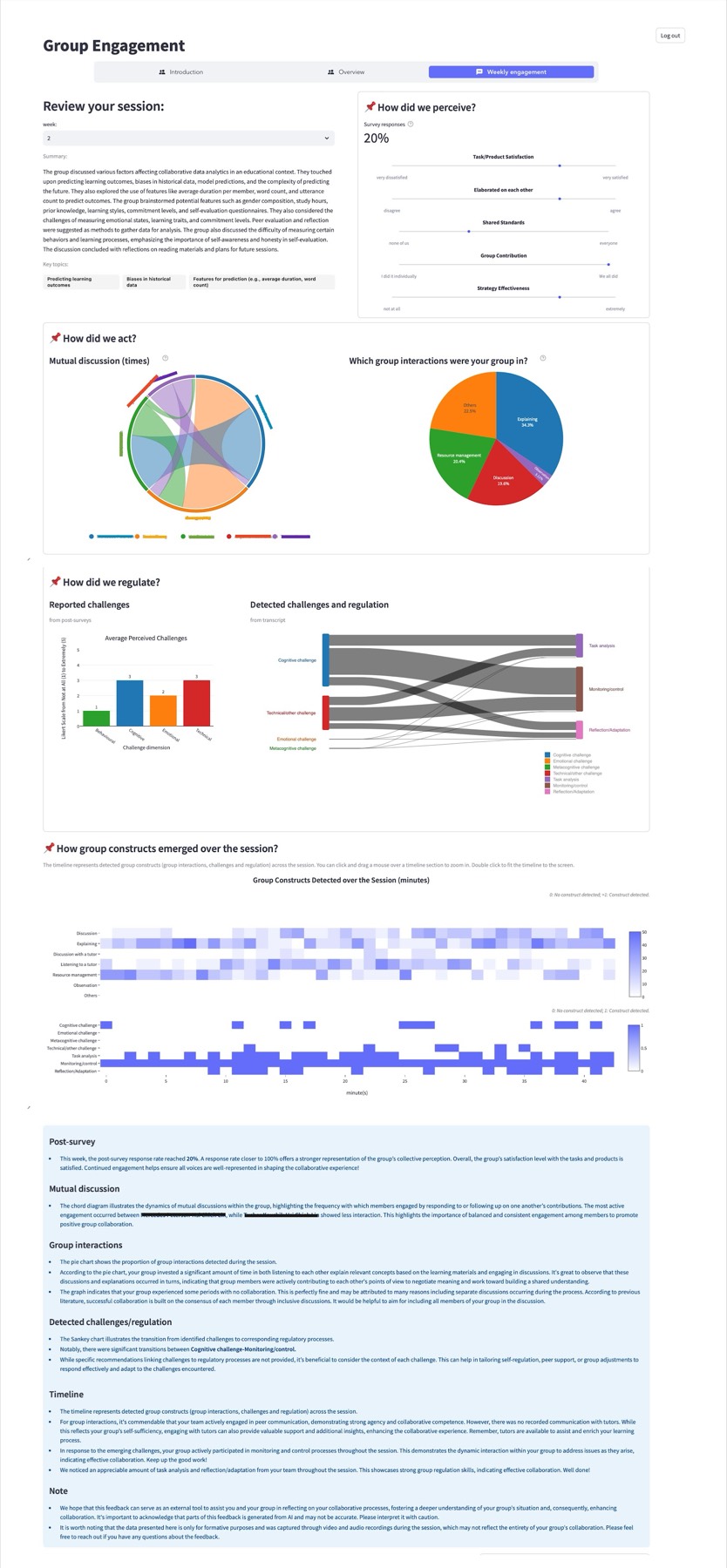
Effective collaboration requires awareness of group challenges and timely regulation. This research investigates how learning analytics can detect challenge moments in small-group discourse and support students' regulation through an NLP-based predictive model and a feedback dashboard. Findings from a real-world deployment show that analytics-driven feedback can raise students' awareness, particularly at the individual level, though group regulation remains limited with practical challenges. This work offers a theoretically grounded, empirically validated framework for detecting and supporting socially shared regulation of learning in authentic higher education settings.
This doctoral research investigates the role of LLM-generated, trace-based feedback in supporting self-regulated learning (SRL) skills in online higher education. Drawing on learning analytics data, it compares LLM- and tutor-generated feedback across multiple feedback instances over a term, moving beyond single-session designs to examine longitudinal SRL development. Both the quality of the feedback produced and learners’ perceptions of it are examined, contextualising its potential instructional value. Findings are expected to contribute to the design of scalable, high-quality feedback interventions in online learning contexts.
Learning analytics feedback, frequently delivered through dashboards and visualisations, holds promise for supporting self-regulated learning (SRL) in higher education, yet students often struggle to interpret and act upon such feedback. This research investigates how scaffolding through a generative AI assistant can mediate students’ engagement with analytics feedback. A first strand of empirical work establishes the relationship between engagement with analytics feedback, SRL competence, and course performance, providing the foundation for design. A second strand analyses the dialogues that emerge between students and a GenAI assistant when interpreting analytics visualisations, characterising the questions students raise and the response patterns that productively support sense-making. Together, the work contributes design principles for AI-scaffolded analytics feedback that bridges visualisation and learner interpretation, with implications for integrating generative AI into feedback infrastructures in higher education.
The psychological and social challenges of adopting AI and analytics in educational practice.
Large language models are rapidly entering educational workflows, including teacher-facing tasks such as formative feedback and assessment, where implicit and context-dependent gender bias may surface through subtle shifts in tone, emphasis, and pedagogical framing with cumulative downstream consequences for students’ motivation, academic identity, and long-term trajectories. Two gaps remain in the field: a lack of robust, replicable, and interpretable benchmarking methods that detect subtle bias beyond template-based audits; and limited empirical evidence on how teacher–LLM interaction co-constructs, amplifies, or corrects model tendencies. This work therefore advances a two-strand programme connecting technical bias benchmarking with interactional bias co-construction. The first strand develops an education-grounded auditing framework using counterfactual educational inputs that differ only in gender cues, benchmarking representative LLMs on authentic student-writing feedback tasks via embedding-space mapping while controlling for stochasticity, with complementary qualitative and text-analytic interpretation. The second strand brings teachers into the loop through a workshop-style behavioural study under no-AI versus AI-assisted conditions, capturing decision changes, confidence shifts, adoption/editing behaviour, and bias indices, towards a taxonomy of human–AI bias interaction regimes.
We welcome PhD students and collaborators who want to push these questions forward.